Random Pride Flag Generator: 42 Flags, Years and Meanings: how it works
This random pride flag generator draws from 42 flags, from Gilbert Baker's eight-stripe rainbow of 1978 to designs from the last few years. Each card gives the year and the designer where the record is clear, then the colors and what they stand for. Thirty-three flags come with a simple drawing. Use it for art palettes, quiz rounds, club displays and flag spotting at a parade.
What is on the list
The 42 flags sit under three chips: 10 rainbow flags, 19 for orientation and relationships, and 13 for gender and intersex. Two more chips sort them by design, with 32 made of plain stripes and 10 that carry a symbol or chevron. Every fact comes from Wikipedia's Pride flag article and the articles it links to, read on 2026-09-18. A year or a designer is printed only where the article states it without a dispute tag. Many flags began as anonymous posts online, so some cards give colors and meaning alone.
Why nine flags are described but not drawn
The drawings are our own rectangles, colored from the Wikimedia Commons file for each flag, and we made one only where that file is marked public domain, CC0 or free to use. The Progress Pride flag by Daniel Quasar is under a Creative Commons licence that excludes commercial use, so it and the intersex-inclusive version appear in words. So do flags whose emblem we chose not to redraw, such as the Labrys lesbian flag. Some designers settled the question themselves: Michael Page said in 1998 that his Bisexual flag was free for public and commercial use.
Ways to use a random flag
Art classes use a draw as a palette brief: paint anything you like, but only in the colors on the card. Quiz setters read out the stripes and ask for the name, or give the name and ask for the year. For a club display, draw five and make a poster panel for each with its date and meanings. Crafters can set the Plain stripes chip and get a pattern for beads, bunting or a friendship bracelet. Writers use a flag as a small, true detail on a fictional character's wall.
Tips
Try the palette challenge: draw one flag, then make a picture of something unrelated, a teapot or a street, using only that flag's colors.
For a quiz round, set the count to 10 and read only the description line. Players name the flag, and the year is the tiebreak.
Press the heart to save a flag. Saved flags stay in your browser, so a display or a sketchbook series can be planned over several visits.
The flag of the day is the same for every visitor until midnight, which suits a daily sketch or a club noticeboard.
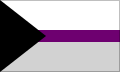
Pick the Symbol or chevron chip for a harder drawing exercise. The Intersex flag needs one clean circle, and the Demisexual flag needs a triangle at the hoist.
Questions and answers
Which pride flag came first?
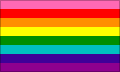
The rainbow flag. Gilbert Baker made it in 1978 with eight stripes: pink for sexuality, red for life, orange for healing, yellow for sun, green for nature, turquoise for art, indigo for harmony and violet for spirit. Hot pink was dropped for lack of fabric. In 1979 turquoise went too and indigo became royal blue, which left the six stripes most people know.
Why does the transgender flag read the same upside down?
Monica Helms designed it that way in 1999. The stripes run light blue, pink, white, pink, light blue, so the flag is correct whichever way it is flown. It was first shown at a pride parade in Phoenix in 2000, and Helms gave the original to the Smithsonian in 2014.
Why do some flags show no year or designer?
Because the record is unclear, and a guess would be worse than a gap. Wikipedia tags the credit for the orange-pink lesbian flag as dubious, and the pansexual flag first appeared on an anonymous account. For the gay men's flags, two articles give different designers and dates, so the card prints neither. The colors and their meanings are still given.
Which flags are easiest to draw or craft?
Start with three equal stripes: the Pansexual flag, the Polysexual flag, the Genderqueer flag and the Neutrois flag. The Bisexual flag is nearly as simple, but its stripes are not equal, since the pink and blue are each twice as deep as the purple. Mirrored flags such as the Agender flag are forgiving, because the bottom half repeats the top.
Which flags are left out?
Flags of adult subcultures are left out because children use this site. Most city and country versions are left out to keep the list general, though the Gay flag of South Africa is in. Flags that Wikipedia shows with no sourced description are left out because we could not check them. The list is reviewed once a year.
Labrys lesbian flagSean Campbell, 1999. A double-headed axe on a black triangle, set on a violet field.
Omnisexual flagDesigned in 2015. Two pink stripes, a dark purple middle stripe and two blue stripes.
Orange-pink lesbian flag, five stripesThe most widely used lesbian flag today: two oranges, white and two pinks.
Orange-pink lesbian flag, seven stripesFrom 2018. Dark orange stands for gender non-conformity and dark rose for femininity.
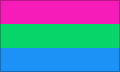
Pansexual flagAppeared online in 2010. Three equal bars of magenta, yellow and cyan.
Pink lesbian flagPinks and reds around a white stripe. The usual lesbian flag until 2018.
Polyamory flag, 1995 designJim Evans, 1995. Blue, red and black stripes with a gold Greek letter pi in the middle.
Polyamory flag, 2022 designRed Howell. Picked from four candidates in an online survey in 2022.
Polysexual flagDesigned in 2012. Pink, green and blue stripes.
Gender and intersex 13
Agender flagSalom X, 2014. Black, gray and white mirrored around green, which stands for non-binary genders.
Bigender flagSeven stripes: two pinks, lavender, white, lavender and two blues.
Demiboy flagBy the designer of the agender flag. Grays outside, light blue inside, white in the center.
Demigirl flagBy the designer of the agender flag. Grays outside, pink inside, white in the center.
Genderfluid flagJamie Poole, 2012. Pink, white, purple, black and blue stripes.
Genderqueer flagMarilyn Roxie, 2011. Lavender for androgyny, white for agender, green for outside the binary.
Intersex flagMorgan Carpenter, 2013. An unbroken purple circle on yellow that stands for wholeness.
Neutrois flagWhite, green and black stripes. The word neutrois was coined in 1995.
Non-binary flagKye Rowan, 2014. Yellow, white, purple and black; yellow is for genders outside the binary.
Pangender flagPale yellow, peach and light pink, mirrored around a white center stripe.
Pellinen transgender flagJennifer Pellinen, 2002. Five stripes that run from pink through three purples to blue.
Transgender flagMonica Helms, 1999. Light blue, pink, white, pink, light blue: correct whichever way it flies.
Trigender flagPink, blue, green, blue and pink stripes, mirrored around the green.
How this list was compiled: Names, years, designers and meanings: English Wikipedia, 'Pride flag' (https://en.wikipedia.org/wiki/Pride_flag) and its linked articles: Rainbow flag (LGBTQ), Progress Pride flag, Gay flag of South Africa, Bisexual flag, Pansexual flag, Asexual flag, Demisexuality, Gray asexuality, Sexual fluidity, Omnisexuality, Polysexuality, Lesbian flags, Gay men's flags, Polyamory, Aromantic flag, Demiromanticism, Aromantic asexuality, Transgender flag, Non-binary flag, Non-binary, Gender fluidity, Agender, Intersex flag and Straight ally. All read 2026-09-18. A year or designer is given only where the article states it without a dispute tag; where two articles disagree (the gay men's flags) both are left out. Stripe colors: read on 2026-09-18 from the Wikimedia Commons file each article shows. Drawings are our own rectangles in those colors, made only for the flags whose Commons file is marked public domain, CC0 or copyrighted free use (x.fileLicense) and whose design is plain geometry. The Progress Pride flag is under a non-commercial Creative Commons licence, so it and the intersex-inclusive version are described in words only, as are flags whose Commons file is CC BY-SA (queer, omnisexual, demiromantic) or whose emblem we did not redraw (labrys, both polyamory flags, South Africa). Left out on purpose: fetish and adult-subculture flags, location flags other than South Africa, and flags Wikipedia lists with no sourced description. Next review by 2027-09-18. Licence: own work