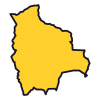
The 12 sovereign countries that the United Nations M49 standard lists under South America, https://unstats.un.org/unsd/methodology/m49/, a closed list. M49 lists 16 entries for the region; the other four are territories, not countries, and sit under optInItems, outside the draw: French Guiana, the Falkland Islands (Malvinas), South Georgia and the South Sandwich Islands, and Bouvet Island. Populations are World Bank Open Data mid-year totals for 2025 (indicator SP.POP.TOTL, https://data.worldbank.org/indicator/SP.POP.TOTL?locations=ZJ, database updated 2026-07-13, CC BY 4.0), rounded on the card. Areas (x.areaKm2) are World Bank surface area for 2023 (indicator AG.SRF.TOTL.K2). Capitals, languages and currencies were checked against each country's article at https://en.wikipedia.org/wiki/List_of_sovereign_states_and_dependent_territories_in_South_America and the country articles linked from it, and currency codes against the ISO 4217 table at https://en.wikipedia.org/wiki/ISO_4217 (Venezuela has two active codes, VES and VED; VES is given). Land neighbours are from https://en.wikipedia.org/wiki/List_of_countries_and_territories_by_number_of_land_borders; French Guiana counts as a neighbour of Brazil and Suriname, and Panama as a neighbour of Colombia. The 'In the Andes' group follows https://en.wikipedia.org/wiki/Andes, which names seven countries. The Spanish-speaking group is the nine countries where Spanish is the official or national language. The Landlocked group is the two rows with no coast (x.landlocked), Bolivia and Paraguay. Guyana and Suriname playing in the North and Central American football confederation, which leaves South America's own with 10 members, was checked against https://en.wikipedia.org/wiki/CONMEBOL . Territory figures: French Guiana 298,554 people (January 2026) and the Falkland Islands 3,662 (2021 census), both as given on their Wikipedia articles. Outlines are the places family's drawings from Natural Earth 5.1.1 (public domain, https://www.naturalearthdata.com/), each scaled to fill its own box, so they are not to a common scale; Chile is drawn without Easter Island and Ecuador without the Galapagos. Bouvet Island has no outline. Everything was checked on 2026-09-18. Licence: own work (list, wording and selection); population and area figures from World Bank Open Data, CC BY 4.0, https://data.worldbank.org/; outlines drawn from Natural Earth, public domain
How it works
South America has only 12 countries, so a random country in South America takes one press: as a card, or as a slice once you press Show as a wheel. Every card shows the capital, official languages, 2025 population, currency and outline.
Read the full guide
A random South American country for reports and quiz night
Twelve countries make twelve report topics: press twelve times and hand them out in the order dealt. A Spanish class can choose Spanish-speaking in the dropdown, which leaves nine and drops Brazil (Portuguese), Guyana (English) and Suriname (Dutch). In a capitals quiz, Bolivia is the trap: Sucre is the constitutional capital, but the government sits in La Paz, so the card names both.
What the 12 cards show that a map hides
Brazil holds nearly half of the continent's people, 213 million of 438 million in 2025, and borders every country here except Chile and Ecuador. Bolivia and Paraguay alone have no coast: Landlocked, in More filters, draws between them. Guyana (1966) and Suriname (1975) are the youngest states.
The closest pair on population is Guyana and Suriname: 836,000 against 640,000. Both play football in the North and Central American confederation, not South America's.
Neighbour round: draw one country and name every place it touches. Brazil has 10 land borders, counting French Guiana. Ecuador and Uruguay have 2 each.
Show as a wheel puts all 12 names in front of a room. A link ending in #andes opens on the seven Andean countries.
Questions and answers
How many countries are in South America?
Twelve: Argentina, Bolivia, Brazil, Chile, Colombia, Ecuador, Guyana, Paraguay, Peru, Suriname, Uruguay and Venezuela. The UN's list for the region has 16 entries, but four are territories and never drawn: French Guiana (France), the Falkland Islands and South Georgia (British) and Bouvet Island (Norway).
Why are Mexico, Panama and Trinidad and Tobago never drawn?
None is South American on the UN list. Mexico and Panama are grouped with Central America, and the continent starts at Panama's border with Colombia. Trinidad and Tobago lies just off Venezuela but counts as Caribbean. Latin America is the wider label for all three.
Which South American country uses the US dollar?
Ecuador: its card gives the United States dollar. The other 11 each print their own money: four pesos (Argentine, Chilean, Colombian, Uruguayan), two dollars (Guyanese, Surinamese), the Brazilian real, Boliviano, Paraguayan guaraní, Peruvian sol and Venezuelan bolívar.