Random Country in Africa: All 54 With Capital, Region and Outline: how it works
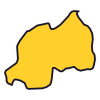
Africa has 54 countries, more than any other continent. Press the button for a random country in Africa, and Guinea-Bissau, Eswatini and Comoros are as likely as Egypt or Nigeria. Each card shows the capital, UN region, 2025 population, official languages and outline, and nothing repeats until all 54 are out.
A random African country for reports and capitals quizzes
Handing out report topics? One press per name on the register gives every student a different country. For a capitals quiz, press Hide all details and tap a cover to check. Three answers catch people: Nigeria's capital is Abuja, not Lagos. Tanzania's is Dodoma, not Dar es Salaam. Ivory Coast's is Yamoussoukro, not Abidjan.
Narrow the draw by region, coastline or language
The five regions are the United Nations' own: Northern Africa has 6, Western 16, Eastern 18, Middle 9 and Southern 5. So Zambia and Zimbabwe are Eastern Africa and Angola is Middle Africa. Landlocked leaves the 16 with no coast. French is official in 19 countries, English in 23 and both in five, Cameroon and Rwanda among them. Rows combine: Western Africa plus Landlocked leaves Burkina Faso, Mali and Niger.
Tips
Population duel: deal two cards, hide the details and bet on the bigger country. Nigeria, at about 238 million, is the largest and Seychelles, at about 123,000, the smallest.
Check an atlas against the Equatorial Guinea card: the capital moved from Malabo to Ciudad de la Paz in January 2026, so most printed maps are wrong.
Before you press, everyone names an African country aloud. With five cards on screen, a match is about 1 in 11.
Questions and answers
How many countries are in Africa?
This page counts 54, the African member states of the United Nations. Western Sahara is a disputed territory, and Réunion, Mayotte and Saint Helena belong to France and the United Kingdom, so none is drawn. The African Union counts 55 members, because it also seats the Sahrawi Republic, which claims Western Sahara.
Why is French missing from Mali, Burkina Faso and Niger?
All three changed their constitutions. Mali made 13 national languages official in 2023 and kept French as a working language, Burkina Faso did the same months later, and Niger made Hausa official in 2025. The French chip leaves all three out.
Where do the capitals and populations come from?
Populations are World Bank figures for 2025. Capitals and official languages were checked against Wikipedia on 18 September 2026. South Africa shows three capitals and Eswatini two: both split the job between cities. Outlines follow UN-recognised borders, so Morocco is drawn without Western Sahara and Somalia with Somaliland. Cabo Verde, São Tomé and Príncipe and Seychelles are too small to draw.
🇩🇿AlgeriaCapital: Algiers. Northern Africa. 47 million people. Official languages: Arabic and Tamazight.
🇪🇬EgyptCapital: Cairo. Northern Africa. 118 million people. Official language: Arabic.
🇱🇾LibyaCapital: Tripoli. Northern Africa. 7.5 million people. Official language: Arabic.
🇲🇦MoroccoCapital: Rabat. Northern Africa. 38 million people. Official languages: Arabic and Tamazight.
🇸🇩SudanCapital: Khartoum. Northern Africa. 52 million people. Official languages: Arabic and English.
🇹🇳TunisiaCapital: Tunis. Northern Africa. 12 million people. Official language: Arabic.
Western Africa 16
🇧🇯BeninCapital: Porto-Novo. Western Africa. 15 million people. Official language: French.
🇧🇫Burkina FasoCapital: Ouagadougou. Western Africa. 24 million people. Official languages: Mooré, Bissa, Dyula, Fula.
🇨🇻Cabo VerdeCapital: Praia. Western Africa. 527,000 people. Official language: Portuguese.
🇬🇲GambiaCapital: Banjul. Western Africa. 2.8 million people. Official language: English.
🇬🇭GhanaCapital: Accra. Western Africa. 35 million people. Official language: English.
🇬🇳GuineaCapital: Conakry. Western Africa. 15 million people. Official language: French.
🇬🇼Guinea-BissauCapital: Bissau. Western Africa. 2.2 million people. Official language: Portuguese.
🇨🇮Ivory CoastCapital: Yamoussoukro. Western Africa. 33 million people. Official language: French.
🇱🇷LiberiaCapital: Monrovia. Western Africa. 5.7 million people. Official language: English.
🇲🇱MaliCapital: Bamako. Western Africa. 25 million people. 13 official languages, including Bambara.
🇲🇷MauritaniaCapital: Nouakchott. Western Africa. 5.3 million people. Official language: Arabic.
🇳🇪NigerCapital: Niamey. Western Africa. 28 million people. Official language: Hausa.
🇳🇬NigeriaCapital: Abuja. Western Africa. 238 million people. Official language: English.
🇸🇳SenegalCapital: Dakar. Western Africa. 19 million people. Official language: French.
🇸🇱Sierra LeoneCapital: Freetown. Western Africa. 8.8 million people. Official language: English.
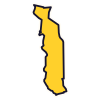
🇹🇬TogoCapital: Lomé. Western Africa. 8.6 million people. Official language: French.
Eastern Africa 18
🇧🇮BurundiCapital: Gitega. Eastern Africa. 14 million people. Official languages: Kirundi, French and English.
🇰🇲ComorosCapital: Moroni. Eastern Africa. 883,000 people. Official languages: Comorian, French and Arabic.
🇩🇯DjiboutiCapital: Djibouti. Eastern Africa. 1.2 million people. Official languages: Arabic and French.
🇪🇷EritreaCapital: Asmara. Eastern Africa. 3.6 million people. Working languages: Tigrinya, Arabic, English.
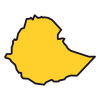
🇪🇹EthiopiaCapital: Addis Ababa. Eastern Africa. 135 million people. 5 official languages, including Amharic and Oromo.
🇰🇪KenyaCapital: Nairobi. Eastern Africa. 58 million people. Official languages: Swahili and English.
🇲🇬MadagascarCapital: Antananarivo. Eastern Africa. 33 million people. Official languages: Malagasy and French.
🇲🇼MalawiCapital: Lilongwe. Eastern Africa. 22 million people. Official language: English.
🇲🇺MauritiusCapital: Port Louis. Eastern Africa. 1.2 million people. Government uses English and French.
🇲🇿MozambiqueCapital: Maputo. Eastern Africa. 36 million people. Official language: Portuguese.
🇷🇼RwandaCapital: Kigali. Eastern Africa. 15 million people. 4 official languages, including Kinyarwanda and English.
🇸🇨SeychellesCapital: Victoria. Eastern Africa. 123,000 people. Official languages: Creole, English and French.
🇸🇴SomaliaCapital: Mogadishu. Eastern Africa. 20 million people. Official languages: Somali and Arabic.
🇸🇸South SudanCapital: Juba. Eastern Africa. 12 million people. Official language: English.
🇹🇿TanzaniaCapital: Dodoma. Eastern Africa. 71 million people. Official languages: Swahili and English.
🇺🇬UgandaCapital: Kampala. Eastern Africa. 51 million people. Official languages: English and Swahili.
🇿🇲ZambiaCapital: Lusaka. Eastern Africa. 22 million people. Official language: English.
🇿🇼ZimbabweCapital: Harare. Eastern Africa. 17 million people. 16 official languages, including Shona and English.
Middle Africa 9
🇦🇴AngolaCapital: Luanda. Middle Africa. 39 million people. Official language: Portuguese.
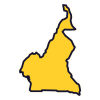
🇨🇲CameroonCapital: Yaoundé. Middle Africa. 30 million people. Official languages: French and English.
🇨🇫Central African RepublicCapital: Bangui. Middle Africa. 5.5 million people. Official languages: Sango and French.
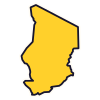
🇹🇩ChadCapital: N'Djamena. Middle Africa. 21 million people. Official languages: French and Arabic.
🇨🇩Democratic Republic of the CongoCapital: Kinshasa. Middle Africa. 113 million people. Official language: French.
🇬🇶Equatorial GuineaCapital: Ciudad de la Paz. Middle Africa. 1.9 million people. 3 official languages, including Spanish.
🇬🇦GabonCapital: Libreville. Middle Africa. 2.6 million people. Official language: French.
🇨🇬Republic of the CongoCapital: Brazzaville. Middle Africa. 6.5 million people. Official language: French.
🇸🇹São Tomé and PríncipeCapital: São Tomé. Middle Africa. 240,000 people. Official language: Portuguese.
Southern Africa 5
🇧🇼BotswanaCapital: Gaborone. Southern Africa. 2.6 million people. Official language: English.
🇸🇿EswatiniCapitals: Mbabane and Lobamba. Southern Africa. 1.3 million people. Official languages: Swazi and English.
🇱🇸LesothoCapital: Maseru. Southern Africa. 2.4 million people. Official languages: Sesotho and English.
🇳🇦NamibiaCapital: Windhoek. Southern Africa. 3.1 million people. Official language: English.
🇿🇦South AfricaCapitals: Pretoria, Cape Town and Bloemfontein. Southern Africa. 65 million people. 12 official languages.
How this list was compiled: The 54 countries are the African entries in the United Nations M49 standard (https://unstats.un.org/unsd/methodology/m49/overview/) that are UN member states, and the five regions are M49's own: Northern, Western, Eastern, Middle and Southern Africa. M49 also lists six areas in Africa that are not countries (Western Sahara, Réunion, Mayotte, Saint Helena, the British Indian Ocean Territory and the French Southern Territories); they are never drawn, and the four with a settled population are kept under optInItems. Populations are the World Bank's 2025 mid-year totals (indicator SP.POP.TOTL, https://data.worldbank.org/indicator/SP.POP.TOTL, last updated 2026-07-13, used under CC BY 4.0) and are rounded on the cards. Capitals were checked against https://en.wikipedia.org/wiki/List_of_national_capitals, which is where the January 2026 move of Equatorial Guinea's capital from Malabo to Ciudad de la Paz comes from (see also https://en.wikipedia.org/wiki/Ciudad_de_la_Paz). Official languages were checked against https://en.wikipedia.org/wiki/List_of_official_languages_by_country_and_territory and each country's own article: Mali (2023), Burkina Faso (2023) and Niger (2025) no longer list French as official, Eritrea names no official language and Mauritius names none in law, though its government works in English and French, so Mauritius sits under both language chips. Landlocked countries are the 16 African members of the UN list of landlocked developing countries, flagged in M49. The territories left out of the draw were checked against https://en.wikipedia.org/wiki/United_Nations_list_of_non-self-governing_territories, https://en.wikipedia.org/wiki/Mayotte, https://en.wikipedia.org/wiki/R%C3%A9union and https://en.wikipedia.org/wiki/Saint_Helena, and the African Union's 55 members, the Sahrawi Republic among them, against https://en.wikipedia.org/wiki/African_Union. The counts in the page copy (6, 16, 18, 9 and 5 countries per region, 16 landlocked, 19 with French and 23 with English official, five under both, the largest and smallest populations) are computed from this dataset. Outlines are drawn from Natural Earth (https://www.naturalearthdata.com/, public domain), each scaled to fill its own box, so they are not to a common scale. Natural Earth draws borders as they are controlled on the ground, so two outlines were redrawn to the borders the UN recognises by joining or leaving out Natural Earth's own pieces: Morocco stops at its southern border and leaves out Western Sahara, which M49 lists as a separate area, and Somalia includes the north-western arm that Natural Earth draws apart as Somaliland. Cabo Verde, São Tomé and Príncipe and Seychelles have no outline because at this size the islands are only dots. Ivory Coast is Côte d'Ivoire in UN usage, and Tanzania, Gambia and the two Congos carry their short English names here. All checked 2026-09-18. Licence: CC BY 4.0 https://creativecommons.org/licenses/by/4.0/ for the population figures (World Bank Open Data). The country list and region names follow the UN M49 standard: the names and codes are facts, the UN's own pages are copyright United Nations (https://www.un.org/en/about-us/copyright, checked 2026-09-18) and none of their text is copied here. Natural Earth map data is public domain. Selection, wording and outline drawings are own work