Random European Country Generator: All 44 With Capital and Currency: how it works
This random European country generator draws from the 44 countries on the United Nations list. Three clubs cut across them: 26 are in the EU, 25 use the euro and 29 are in the Schengen Area. For a random country in Europe, press the button. Each card gives the capital, 2025 population, languages, currency, EU status and outline.
For capitals quizzes and country reports
For a capitals quiz, press Hide all details and guess before you tap. Bern is the trap: Switzerland's capital is its fifth largest city, not Zurich or Geneva. For reports, draw 20 and let students claim from the screen: nothing repeats until all 44 are out.
Filter by region, EU, euro, Schengen or coastline
Regions follow the United Nations list: Eastern Europe has 10 countries, Northern 10, Southern 15 and Western 9. So the United Kingdom counts as Northern Europe and Czechia as Eastern. Ireland is in the EU but outside Schengen, while Iceland, Liechtenstein, Norway and Switzerland are the reverse. Rows combine: In the European Union plus Landlocked leaves Austria, Czechia, Hungary, Luxembourg and Slovakia. Monaco and Vatican City are too small to outline.
Tips
Draw two and guess which has more people. Nine of the 44 have fewer than a million, and Vatican City has 882 residents.
Guess the currency before you look. Six EU members keep their own money: Czechia, Denmark, Hungary, Poland, Romania and Sweden. Five countries outside the EU use the euro, Montenegro among them.
For a trip game, set Club to In the Schengen Area, draw five and plan one route.
Questions and answers
How many countries are in Europe?
This page counts 44: the 43 UN members the United Nations files under Europe, plus Vatican City, listed as the Holy See, a UN observer. Longer lists add Cyprus, Turkey, Georgia, Armenia, Azerbaijan and Kazakhstan, which the UN files under Asia, and Kosovo, which is not a UN member. None of those seven is drawn.
Why does the EU chip show 26 countries, not 27?
The 27th member is Cyprus, which the United Nations files under Western Asia, so it is not among the 44. The euro chip has the same gap: 20 of the 21 euro-area members, plus five users outside the EU. The newest is Bulgaria, where the euro replaced the lev on 1 January 2026.
Is Russia in Europe or Asia?
Both. About 3.95 million square kilometres lie west of the Ural Mountains, almost 40 percent of Europe, and more lies in Asia. The United Nations counts all of it under Eastern Europe, so Russia is in this draw. Outlines follow the borders the UN recognises: Ukraine, the largest country entirely in Europe, is drawn with Crimea and Russia without it.
🇦🇹AustriaCapital: Vienna. 9.2 million people. German. Euro. In the EU since 1995.
🇧🇪BelgiumCapital: Brussels. 12 million people. Dutch, French and German. Euro. EU founding member.
🇫🇷FranceCapital: Paris. 69 million people. French. Euro. EU founding member.
🇩🇪GermanyCapital: Berlin. 83 million people. German. Euro. EU founding member.
🇱🇮LiechtensteinCapital: Vaduz. 41,000 people. German. Swiss franc. Not in the EU.
🇱🇺LuxembourgCapital: Luxembourg. 687,000 people. French, German and Luxembourgish. Euro. EU founding member.
🇲🇨MonacoA city-state on the coast of France. 38,000 people. French. Euro. Not in the EU.
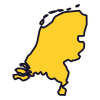
🇳🇱NetherlandsCapital: Amsterdam. 18 million people. Dutch. Euro. EU founding member.
🇨🇭SwitzerlandCapital: Bern. 9.1 million people. German, French, Italian and Romansh. Swiss franc. Not in the EU.
Northern Europe 10
🇩🇰DenmarkCapital: Copenhagen. 6 million people. Danish. Danish krone. In the EU since 1973.
🇪🇪EstoniaCapital: Tallinn. 1.4 million people. Estonian. Euro. In the EU since 2004.
🇫🇮FinlandCapital: Helsinki. 5.6 million people. Finnish and Swedish. Euro. In the EU since 1995.
🇮🇸IcelandCapital: Reykjavík. 392,000 people. Icelandic and Icelandic Sign Language. Icelandic króna. Not in the EU.
🇮🇪IrelandCapital: Dublin. 5.5 million people. Irish and English. Euro. In the EU since 1973.
🇱🇻LatviaCapital: Riga. 1.8 million people. Latvian. Euro. In the EU since 2004.
🇱🇹LithuaniaCapital: Vilnius. 2.9 million people. Lithuanian. Euro. In the EU since 2004.
🇳🇴NorwayCapital: Oslo. 5.6 million people. Norwegian and Sami. Norwegian krone. Not in the EU.
🇸🇪SwedenCapital: Stockholm. 11 million people. Swedish. Swedish krona. In the EU since 1995.
🇬🇧United KingdomCapital: London. 69 million people. English. Pound sterling. Left the EU in 2020.
Southern Europe 15
🇦🇱AlbaniaCapital: Tirana. 2.3 million people. Albanian. Albanian lek. EU candidate.
🇦🇩AndorraCapital: Andorra la Vella. 83,000 people. Catalan. Euro. Not in the EU.
🇧🇦Bosnia and HerzegovinaCapital: Sarajevo. 3.1 million people. Bosnian, Croatian and Serbian. Convertible mark. EU candidate.
🇭🇷CroatiaCapital: Zagreb. 3.9 million people. Croatian. Euro. In the EU since 2013.
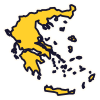
🇬🇷GreeceCapital: Athens. 10 million people. Greek. Euro. In the EU since 1981.
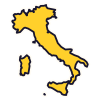
🇮🇹ItalyCapital: Rome. 59 million people. Italian. Euro. EU founding member.
🇲🇹MaltaCapital: Valletta. 580,000 people. Maltese and English. Euro. In the EU since 2004.
🇲🇪MontenegroCapital: Podgorica. 623,000 people. Montenegrin. Euro. EU candidate.
🇲🇰North MacedoniaCapital: Skopje. 1.8 million people. Macedonian and Albanian. Macedonian denar. EU candidate.
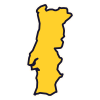
🇵🇹PortugalCapital: Lisbon. 11 million people. Portuguese. Euro. In the EU since 1986.
🇸🇲San MarinoCapital: San Marino. 34,000 people. Italian. Euro. Not in the EU.
🇷🇸SerbiaCapital: Belgrade. 6.5 million people. Serbian. Serbian dinar. EU candidate.
🇸🇮SloveniaCapital: Ljubljana. 2.1 million people. Slovene. Euro. In the EU since 2004.
🇪🇸SpainCapital: Madrid. 49 million people. Spanish. Euro. In the EU since 1986.
🇻🇦Vatican CityA city-state inside Rome. 882 people. Italian and Latin. Euro. Not in the EU.
Eastern Europe 10
🇧🇾BelarusCapital: Minsk. 9.1 million people. Belarusian and Russian. Belarusian ruble. Not in the EU.
🇧🇬BulgariaCapital: Sofia. 6.4 million people. Bulgarian. Euro. In the EU since 2007.
🇨🇿CzechiaCapital: Prague. 11 million people. Czech. Czech koruna. In the EU since 2004.
🇭🇺HungaryCapital: Budapest. 9.5 million people. Hungarian. Hungarian forint. In the EU since 2004.
🇲🇩MoldovaCapital: Chișinău. 2.4 million people. Romanian. Moldovan leu. EU candidate.
🇵🇱PolandCapital: Warsaw. 36 million people. Polish. Polish złoty. In the EU since 2004.
🇷🇴RomaniaCapital: Bucharest. 19 million people. Romanian. Romanian leu. In the EU since 2007.
🇷🇺RussiaCapital: Moscow. 144 million people. Russian. Russian ruble. Not in the EU. Spans Europe and Asia.
🇸🇰SlovakiaCapital: Bratislava. 5.4 million people. Slovak. Euro. In the EU since 2004.
🇺🇦UkraineCapital: Kyiv. 39 million people. Ukrainian. Ukrainian hryvnia. EU candidate.
How this list was compiled: The 44 countries are the European entries in the United Nations M49 standard (https://unstats.un.org/unsd/methodology/m49/overview/) that are states: 43 UN member states (https://en.wikipedia.org/wiki/Member_states_of_the_United_Nations) plus the Holy See, a UN observer, shown as Vatican City. The four region chips are M49's own: Eastern Europe 10, Northern Europe 10, Southern Europe 15, Western Europe 9. M49 also lists seven places in Europe that are not states (Åland, the Faroe Islands, Gibraltar, Guernsey, the Isle of Man, Jersey, and Svalbard and Jan Mayen); they are never drawn. M49 files Cyprus, Turkey, Georgia, Armenia and Azerbaijan under Western Asia and Kazakhstan under Central Asia, and Kosovo is not in M49; those seven are kept under optInItems and are not in the draw. M49 counts all of Russia in Europe, and its card says it spans two continents. Populations are the World Bank's 2025 mid-year totals (indicator SP.POP.TOTL, https://data.worldbank.org/indicator/SP.POP.TOTL, last updated 2026-07-13, used under CC BY 4.0), rounded on the cards. The World Bank has no figure for the Holy See, so Vatican City shows the 882 residents counted on 31 December 2024 by the Vatican City State (https://www.vaticanstate.va/it/stato-governo/note-generali/popolazione.html). Capitals were checked against https://en.wikipedia.org/wiki/List_of_national_capitals (Amsterdam and The Hague, Bern, Podgorica and Cetinje, and the city-states Monaco and Vatican City) and, for Bern's standing as federal city since 1848 and fifth largest Swiss city, https://en.wikipedia.org/wiki/Bern. Official languages were checked against https://en.wikipedia.org/wiki/List_of_official_languages_by_country_and_territory, which gives none in law for the United Kingdom and for Bosnia and Herzegovina; their cards show the languages used in practice. Currencies were checked against https://en.wikipedia.org/wiki/List_of_circulating_currencies. The 27 EU members and their accession years are from https://en.wikipedia.org/wiki/Member_state_of_the_European_Union (26 are in this list; Cyprus is the 27th; the six founders are dated 1958, when the European Economic Community began; the United Kingdom left on 31 January 2020). The nine EU candidates are from https://en.wikipedia.org/wiki/Potential_enlargement_of_the_European_Union. The 21 euro-area members, Bulgaria since 2026 among them, the four microstates that use the euro by agreement (Andorra, Monaco, San Marino, Vatican City) and the two that adopted it on their own (Montenegro, Kosovo) are from https://en.wikipedia.org/wiki/Eurozone, and the date the euro replaced the Bulgarian lev, 1 January 2026, from https://en.wikipedia.org/wiki/Bulgarian_lev. The 29 Schengen members (25 EU members plus Iceland, Liechtenstein, Norway and Switzerland; Ireland and Cyprus are outside) are from https://en.wikipedia.org/wiki/Schengen_Area. The 14 landlocked countries are from https://en.wikipedia.org/wiki/Landlocked_country. European Russia's 3,952,550 sq km and 39.5 percent share, and Kazakhstan's share, are from https://en.wikipedia.org/wiki/List_of_European_countries_by_area; Turkey's 3 percent is from https://en.wikipedia.org/wiki/East_Thrace; Kosovo's 2008 declaration is from https://en.wikipedia.org/wiki/Kosovo. Outlines are drawn from Natural Earth (https://www.naturalearthdata.com/, public domain), each scaled to fill its own box, so they are not to a common scale. Natural Earth draws borders as they are controlled on the ground, so three outlines were redrawn to the borders the UN recognises by joining Natural Earth's own pieces: Ukraine includes Crimea, Russia does not, and Cyprus (an opt-in card) is the whole island. Monaco and Vatican City have no outline because they are too small to draw even from 1:10m data. Czechia, Moldova, Russia and the Netherlands carry their short English names; x.unName keeps the UN's wording. All checked 2026-09-18. Licence: CC BY 4.0 https://creativecommons.org/licenses/by/4.0/ for the population figures (World Bank Open Data, https://data.worldbank.org/). The country list and region names follow the UN M49 standard: the names and codes are facts, the UN's own pages are copyright United Nations (https://www.un.org/en/about-us/copyright, checked 2026-09-18) and none of their text is copied here. Natural Earth map data is public domain. Selection, wording and outline drawings are own work